Dont Ever Record Me Again or I ll Beat the
Warning: The post-obit story contains plot spoilers for "Don't Look Up," including the ending. If you oasis't all the same seen the film, we advise reading the review and this articulation interview with director Adam McKay and stars Leonardo DiCaprio and Jennifer Lawrence instead. So come up back when you've seen it.
Adam McKay knows full well how the large Hollywood movie about the impending global cataclysm is typically supposed to go.
Bruce Willis blows up the asteroid. The Avengers beat dorsum the conflicting invasion. Superman flies around the world fast enough to plough back time. Everyone leaves the theater auspicious, reassured that life will go along.
That is exactly what McKay didn't want to exercise with his star-studded film "Don't Look Up," which arrives on Netflix Friday.
A warning about the climate crunch wrapped in the guise of a movie about an impending comet impact, "Don't Look Up" ends with the worst case scenario coming to fruition: World leaders don't rising to the occasion. Technology doesn't relieve the mean solar day. The comet slams into the planet and wipes out every living thing. Even the scattering of privileged, wealthy people who manage to escape to another planet are immediately gobbled up by alien creatures.
Did we mention information technology's a one-act?
In denying the audition that usual experience-good conclusion, McKay — inspired by dark comedies similar "Dr. Strangelove" — hoped to evangelize a wake-upwards call to those who would happily continue hitting the snooze push when information technology comes to addressing the real threat of climate change.
"We've seen hundreds of movies where the earth is well-nigh to end, whether it's Marvel movies or James Bond or the '70s disaster movies, and it always works out," McKay told The Times recently. "I think it's not crazy to say that maybe that's part of the reason nosotros're not taking the collapse of the livable atmosphere seriously. Elon Musk was asked about climate change and basically said, 'I know that technology will have care of it.' That sounds like someone who's seen a lot of movies where you know that in the third act it'south going to work out. … For people to encounter a movie that ends where people don't work to get the happy ending — hopefully some people will take a reaction to that."
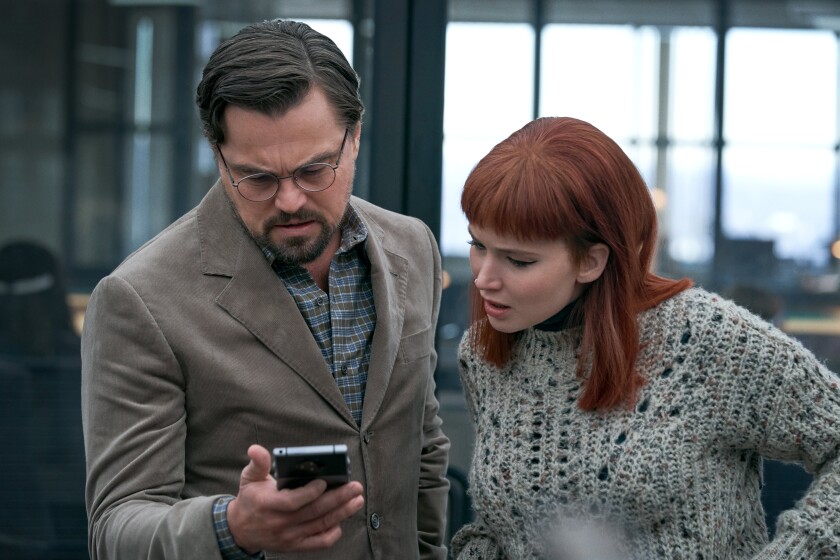
DiCaprio and Lawrence in "Don't Look Upwardly."
(Niko Tavernise / Netflix)
Leonardo DiCaprio and Jennifer Lawrence, who play a pair of obscure astronomers who discover the comet and struggle to get the world to take the threat seriously, were drawn to the project non just by the sharp-edged one-act only past the very bleakness of the ending.
"The end of this movie gets really night, and had information technology not had that tonal shift, I don't think we would have been as excited every bit we were to practise it," said DiCaprio, who has been working to enhance alarms about climate change for years. "You can never tell what a movie is going to do culturally, but the end of this film is really a smack in the face."
"I'thou sure I tin say this on behalf of pretty much everybody: Information technology's extremely frustrating to be a citizen that believes in climate change and is scared, but I'chiliad not a office of it — you know, I can't purchase a senator — so nosotros're just kind of helpless," said Lawrence. "And finally, this [projection] came forth and information technology was merely funny and urgent."
The moving-picture show was in production as the coronavirus pandemic was raging, giving McKay and his cast a existent-fourth dimension example study of society's chaotic and polarized response to a global crisis — and confirming the film was on the right rails in predicting that such a response might not end so well.
"Information technology was already a crazy script but I would say reality out-crazied us by like x to 15%," McKay said. "Well washed, reality."
In the early days of the pandemic, McKay actually drew a measure of hope from the collective spirit of the initial lockdown that mayhap the world could rally together with similar resolve to accost the climate crunch.
"The scientific community has been trying to make this connectedness most how all of our deportment are going to impact everybody — so hither you have this once-in-a-century virus, and everyone is staying home," McKay says. "Y'all constantly hear the practicalities of why you tin can't stop the fossil fuel economy but boy did we make a lot of change awfully fast when information technology came to COVID. Eventually a lot of it fell autonomously but I thought information technology was a good sign that when we're properly scared, some big one-time change can come up our way."
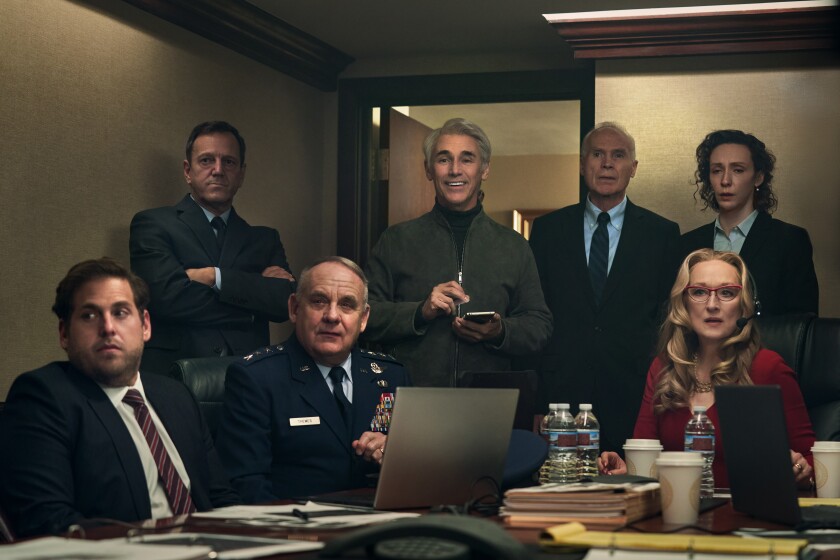
(Left to correct) Jonah Hill, Paul Guilfoyle, Mark Rylance and Meryl Streep in a scene from "Don't Look Up."
(Niko Tavernise / Netflix)
As McKay sees it — and as "Don't Await Upwardly" mercilessly satirizes — the biggest obstacle to that change is our disability in the 21st century media ecosystem to communicate with one another effectively nearly serious matters, fifty-fifty, or possibly especially, when the fate of the world hangs in the balance.
"The cardinal conceit [of the picture show] is that nosotros've screwed up the way we talk to each other by profitizing even the about casual of exchanges," he said. "Whether it's Snapchat or TikTok or social media or the news, you have to become ratings, yous have to get clicks. This isn't blaming whatever people or proverb anyone'south evil. It'southward the system that we've created. Simply nosotros're in a really dangerous situation considering when everything is a sales commutation, you're never going to hear the dark truth."
As grim as the prospect of global doom may be, "Don't Expect Up" does cease on a note of, if non hopefulness, at least poignancy. In their terminal moments before the comet hits, DiCaprio's Dr. Mindy and Lawrence'southward Kate Dibiasky get together with friends and loved ones over dinner, taking comfort in one some other's company, sharing mundane gratitudes and making whistling-by-the-apocalypse small-scale talk.
"That's what I loved nigh the ending, considering I felt like that's ultimately how I would respond," said DiCpario. "Nosotros're a communal species, and I would want to be effectually people I love and ignore the impending Armageddon. That dinner table scene is really what clinched it for me."
Faced with the real imminent end of the earth, McKay says he would immediately become a full-time smoker again and seek out the unhealthiest cheese steak he could discover. Only he hopes he would somewhen find his style to a like kind of grace.
"I had a heart attack about two and a half years ago; fortunately, information technology was a mild one and there was no damage done, thank God," he said. "But man, I couldn't stop smiling for similar three days. I was in the best mood you've ever seen. I was like, 'I'one thousand alive!' And I've heard that when people are terminally sick some people have that reaction, that every moment becomes and so delicious and precious. I'd be curious to see if some of that would kick in."
Source: https://www.latimes.com/entertainment-arts/movies/story/2021-12-24/dont-look-up-ending-explained-netflix-adam-mckay
0 Response to "Dont Ever Record Me Again or I ll Beat the"
Post a Comment